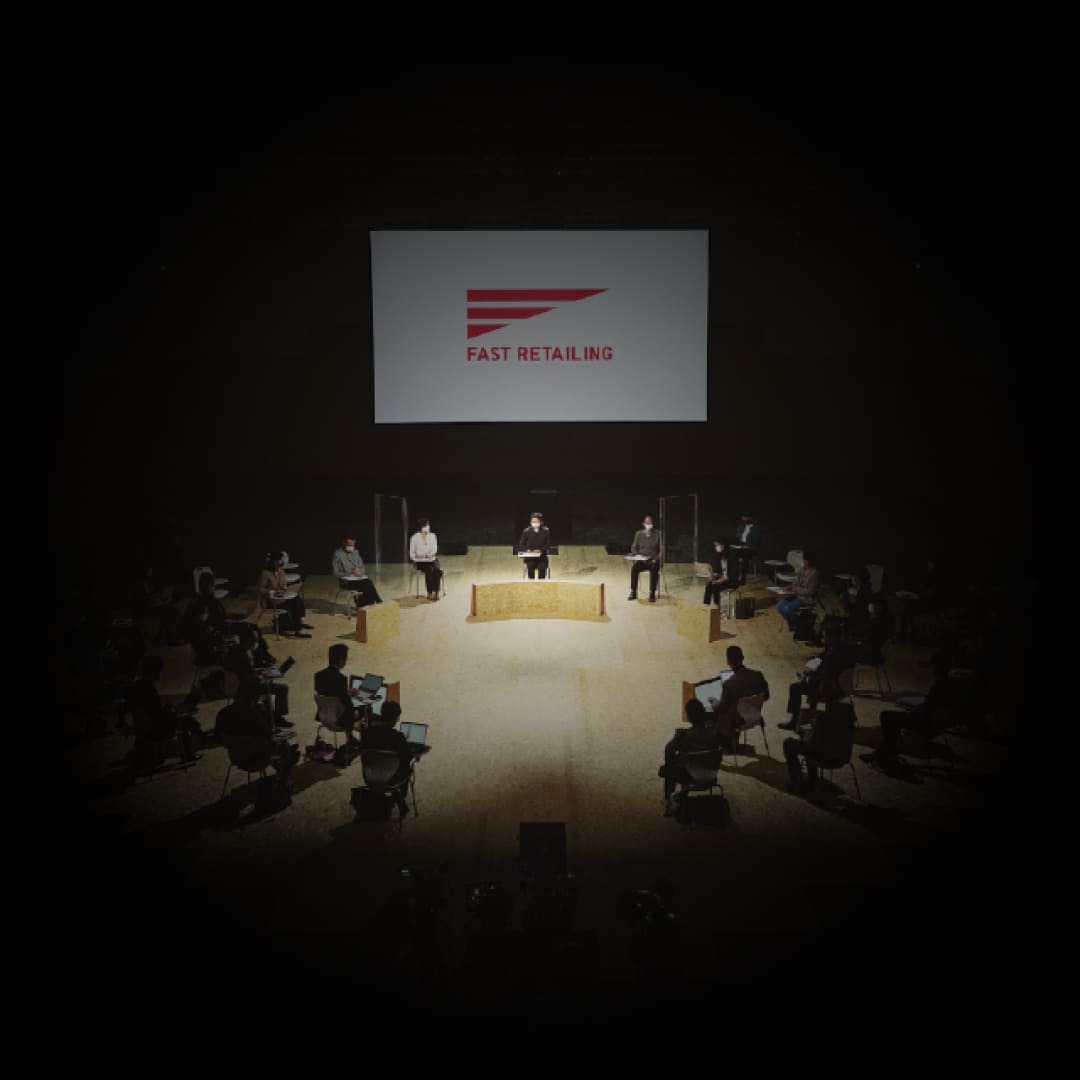

LifeWear clothing is designed to make everyone's life better. Driven by that philosophy, UNIQLO aspires to create a new industry that pursues business activities and sustainability in tandem. That means developing products based on customer feedback; making, transporting, and delivering just the right amount of clothing at the exact time that it is needed; encouraging customers to wear their favourite clothes for longer; and maximising the value of clothes by not throwing them away when they are no longer needed. That’s the future we aspire to achieve. We are only able to conduct our business because we live in a stable society. We aspire to create a business that encourages more and more people to choose LifeWear and to see the world steer in a better direction.
Here, we introduce what progress has been made, along with specific figures and targets.
Reducing greenhouse gas emissions
To mitigate our impact on climate change and biodiversity, Fast Retailing acknowledges the greenhouse gas (GHG) emission long-range targets set under the United Nations Framework Convention on Climate Change (the Paris Agreement) to reduce GHG emissions by 2050. We are working to identify and reduce GHG emissions across all our business activities, from product manufacturing to product disposal, to help achieve these goals.
Promoting our Ariake Project
Reducing environmental impact through digital technology and the integration of sustainability and business activities
We create products that are inspired by customer needs, analysing abundant customer requests and insights gathered through our stores and our e-commerce operations worldwide. We have already developed and delivered several highly-functional ranges including AIRism, Ultra Light Down, and HEATTECH.
By taking our Ariake Project to an even higher level, we hope to make, transport, and sell only the clothes that customers truly want, thereby increasing customer satisfaction and mitigating our environmental impact.
Promoting RE.UNIQLO
Aiming to reduce environmental impact through efficient resource use
UNIQLO's RE.UNIQLO initiative encourages customers to give clothes that they no longer need a new lease of life. RE.UNIQLO STUDIOs in UNIQLO stores offer repair and remake services so that customers can wear their favourite clothes for longer.
Promoting social contribution activities worldwide
UNIQLO aspires to grow and prosper alongside the local communities where we do business, proactively contributing to solutions within these markets and regions. We believe it is important to help ensure stable economic and social conditions in each community, so we engage in activities that benefit local society through our stores, human resources, products, expertise, and anything else we have to offer.
Investment in social contribution activities
Investment in social contribution activities Target FY2025
Investment in social contribution activities Target FY2025
10billion JPY
Progress FY2023 investment total
Progress FY2023 investment total
8.2billion JPY
*Actual combined investment by the Fast Retailing Group, Fast Retailing Foundation, Yanai Tadashi Foundation and Yanai family
Active investment to meet local community needs and solve issues
As part of Fast Retailing’s social contribution investment programme, we launched a project in September 2022 together with the United Nations High Commissioner for Refugees (UNHCR) to help Rohingya refugee women in Bangladesh develop greater self-reliance. At the request of UNHCR, we donated 1 million euros (roughly 140 million yen) following the Turkey-Syria earthquake in February 2023. We also work with our UNIQLO ambassadors to nurture future generations. In April 2023, we held an event to support future wheelchair tennis players together with Shingo Kunieda and Gordon Reid. In August, we held an event with Roger Federer that brought together the themes of art, tennis and culture to encourage children to play an active role in the world. Meanwhile, the Fast Retailing Foundation joined the Philanthropy Asia Alliance (PAA) which brings together philanthropic organisations from around the world to catalyse solutions to challenges surrounding the natural environment, education and public health in Asia.
Providing clothing support
Target FY2025
Target FY2025
10million items per year
Progress FY2024
Progress FY2024
4.7million items
*Including new and secondhand items
Collecting and recycling used clothes to support self-reliance programmes for socially vulnerable people and provide emergency support
Our partnerships with UNHCR and other organisations such as international NGO JOICFP enable UNIQLO, GU, Theory and Comptoir des Cotonniers to put collected garments to good use: by donating them to refugees and internally displaced persons worldwide; by helping women and young people gain more independence, or; as clothing relief in times of natural disaster. Some of the secondhand UNIQLO clothes collected for recycling or reinvention through the RE.UNIQLO programme are also being used to support refugees. It is very important to gain detailed knowledge of local needs so we can deliver clothes that will be the most useful to people who need them. We work with UNHCR, non-profit organisations, and NGOs around the world, carefully checking the number and type of clothes required and the potential delivery routes to ensure only the clothes people really need get to where they need to go. As of 2024 we have donated approximately 58.97 million items of clothing since we started these activities in 2006.
Recipients: refugees and people in socially vulnerable positions, future leaders, people in the arts, culture and sport
Target FY2025
Target FY2025
10million people
Progress FY2024
Progress FY2024
2.34million people
Growing and prospering alongside local communities. Providing consistent support for a stable and invigorated society
We believe it is important to provide consistent support to people in socially vulnerable positions to promote a stable and flourishing society, and to grow and prosper together with the communities we serve.
For example, we offer comprehensive support to refugees that includes self-reliance and vocational training and job-hunting to help them regain their independence. We aim to provide consistent support to all people who have been forced to flee their homes, regardless of their country of birth or circumstances. Supporting young people and children who will grow up to steer our future society is another part of our community engagement. We support education and provide opportunities for social advancement by offering outreach classes taught by Fast Retailing employees, work experience opportunities, and university scholarship programmes. Through our support for culture and the arts, we develop activities that enable local people to experience art first hand, and offer children opportunities to interact with athletes, discover their favourite sport, and lead active lifestyles.
Improving supply chain transparency and establishing traceability
Fast Retailing believes that respecting fundamental human rights and ensuring the health, safety, and security of all workers in our supply chain is our most important responsibility. We have a zero-tolerance policy regarding human rights violations (especially child labour, forced labour, harassment, discrimination, and violence) and work with our production partners to build systems and ensure compliance.
Disclosing information that gives customers peace of mind
We aim to improve transparency as we establish greater traceability
We want our customers to be able pick up our products with trust and use them for a long time, so we have started to provide information on where and how each individual product was made. From August 2023, UNIQLO and GU online stores in some countries added a new Production section to product pages, which displays information on where each product was produced. We plan to expand this initiative to other markets and explore what information our customers would like to see so we can expand the amount of information offered.
Workplace monitoring and evaluation
Implementing more effective monitoring to improve working environments
Fast Retailing requires its partner factories to comply with the Code of Conduct for Production Partners set up in 2004 and monitors working environments based on this code. Employees from the Production Department, which is responsible for product quality and production process management, are assigned to our production offices in Shanghai, Ho Chi Minh City, Dhaka, Jakarta, and Bangalore and visit supplier factories on a weekly basis. There, they can gain a clear understanding of how the factories operate, offer guidance on correct production process, and promote responsible procurement hand in hand with our production partners. We also publish lists of all our garment factories and core fabric mills, and factories to which some parts of the production process are outsourced.
Empowerment programme for women in Bangladesh
Career-building support for aspiring female managers
In March 2023, we added targets to our Women’s Empowerment Programme in Bangladesh as part of our ongoing efforts to help women working in the garment industry advance their careers. More specifically, we set targets to ensure (1) 1,500 female employees receive management training, (2) the ratio of female managers at target factories is increased to an average of 30% or higher, and (3) all female employees can get easy access to childcare, services that promote better physical and mental health and a safe means of commuting to work. We aim to achieve these targets by the end of 2025 with the help of eight of our core garment factories in Bangladesh.
As of the end of August 2025, we have achieved both numerical targets: 2,834 training participants and a female management ratio of 32%. We are also steadily progressing in creating an environment where women can work with peace of mind, such as introducing new childcare facilities at major factories in collaboration with specialised providers. We will consider and implement what is necessary for Bangladesh's apparel industry to sustainably develop as a field where women can thrive. We believe this will lead to continuously enhancing the value we provide to our customers through improved factory productivity and quality.