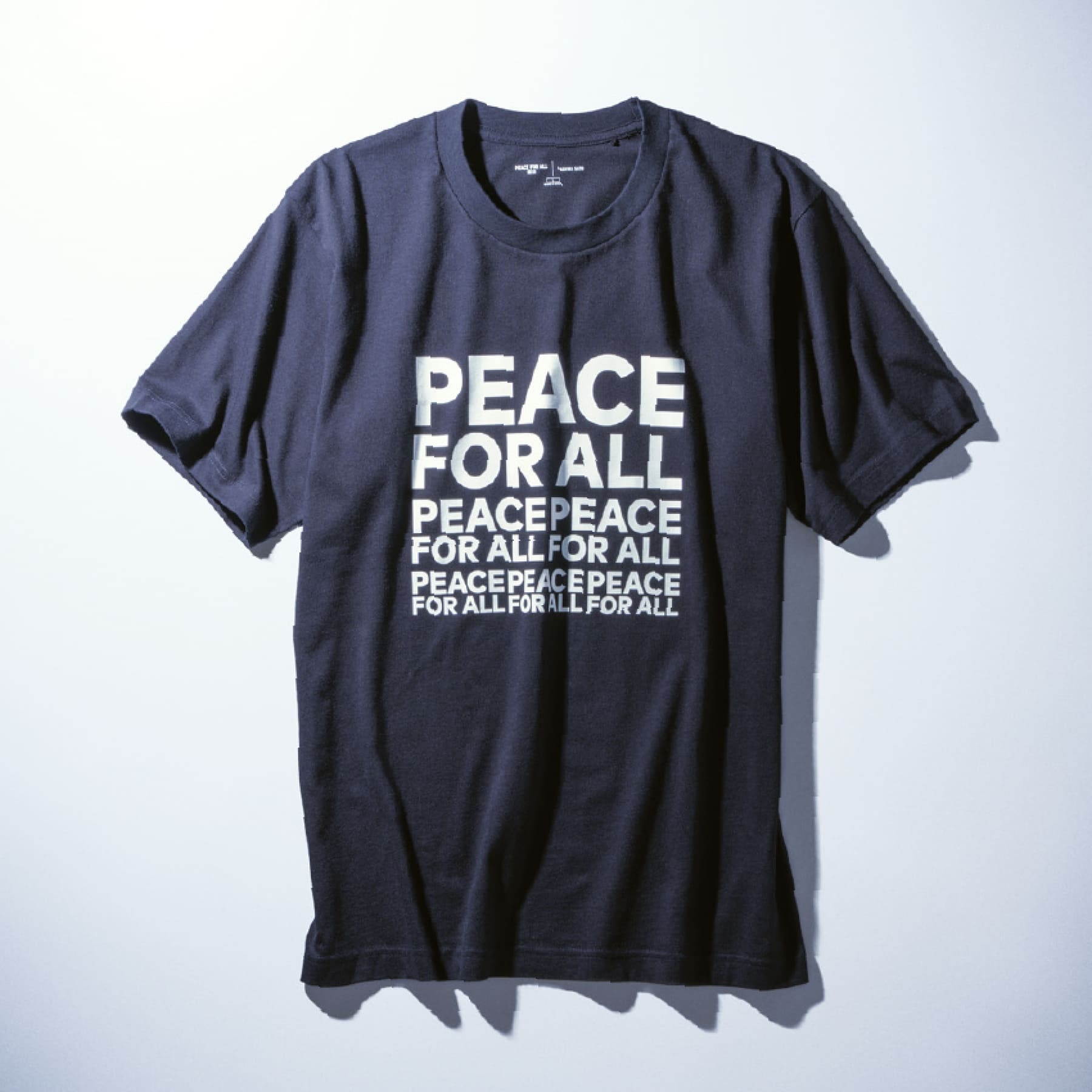
How PEACE FOR ALL is taking action in the name of peace
The PEACE FOR ALL mission to take action for world peace is made possible through collaboration with individuals and organisations around the world. Thanks to a shared goal, UNIQLO is engaged in peace-building programmes all over the globe. Discover the global impact our customers have contributed to by purchasing and wearing PEACE FOR ALL T-shirts.
Total raised for charity from T-shirt sales through the project as of February 2026
Total raised for charity from T-shirt sales through the project as of February 2026
What we can do to make today more peaceful than yesterday
The PEACE FOR ALL mission to take action for world peace is made possible through collaboration with individuals and organisations around the world. Thanks to a shared goal, UNIQLO is engaged in peace-building programmes all over the globe. Discover the global impact our customers have contributed to by purchasing and wearing PEACE FOR ALL T-shirts.
How PEACE FOR ALL is taking action in the name of peace
United Nations High Commissioner for Refugees(UNHCR)
UNHCR, the UN Refugee Agency, leads international action to protect people forced to flee their homes because of conflict and persecution. UNHCR delivers life-saving assistance like shelter, food and water, helps to safeguard fundamental human rights, and develops solutions that ensure people have a safe place to call home where they can build a better future. UNHCR also works to ensure that stateless people are granted a nationality. Present in 135 countries globally, UNHCR received the Nobel Peace Prize in 1954 and 1981.
*Calculated from the total of US$4,004,493 at the April 30,2025 exchange rate of US$1=JPY 142.52
Supporting Bangladesh
53.7%
Overall UNHCR activities
25%
Emergency humanitarian aid
18.5%
Other (Pakistan flood emergency assistance, Cyclone Mocha emergency assistance)
2.8%
Humanitarian aid for Ukraine Emergency:
Providing safe spaces for people fleeing Ukraine
The war in Ukraine has resulted in not only harrowing casualties and damage to infrastructure, but has also brought about a massive refugee crisis. The number of refugees fleeing Ukraine exceeded 6.9 million by March 20th, 2025, 92% of whom are displaced throughout Europe. But refugees have also sought shelter beyond Europe and found warm welcomes. UNHCR maintains a presence in Ukraine and neighbouring countries who have welcomed refugees because the people from Ukraine need our aid and support as much as ever. Over the three years since the sudden outbreak of armed conflict, 12.7 million people in Ukraine (around 35% of the population) have required humanitarian aid. At present, over 29% of country's population is displaced.
UNHCR's support in Ukraine from 2022-2024
Recipients of cash assistance
Recipients of cash assistance
2,100,000
Home repairs
Home repairs
37,000+
Recipients of emergency shelter kits
Recipients of emergency shelter kits
410,000+
People who are forced to flee require aid, which UNHCR cannot provide on its own. Partnering with other UN agencies and international NGOs, UNHCR supports the governments of neighbouring countries to ensure the safety of evacuees, thus playing an essential role in the Ukraine Regional Refugee Response Plan (RRRP). In 2022, RRRP brought together 142 partnering organisations, while in 2024 the total rose to 312. Leveraging these partnerships, UNHCR plays a crucial role in providing protection, shelter, provisions and the coordination and management of temporary facilities providing protection and assistance within Ukraine. Since February 2022, as circumstances permitted, the UNHCR team has operated not only in western Ukraine, but in the east and south, where aid can be harder to deliver. Cooperating with local and international partners, UNHCR delivered emergency shelter repair kits for those whose homes have been damaged, conducted home repairs and provided legal aid and psychological counselling to those suffering from trauma caused by war. A portion of donations from PEACE FOR ALL helps to fund these activities.
Rebuilding everyday life after disaster and supporting livelihoods in Myanmar and Bangladesh
As of February 28th, 2025, there were about 1 million Rohingya refugees in Bangladesh. For several decades, Bangladesh has provided a safe haven for large numbers of Rohingya refugees fleeing Myanmar. However, refugees and asylum seekers have been unable to obtain legal status, and are exposed to danger.
On May 14th, 2023, Cyclone Mocha struck the coastal regions near the border of Myanmar and Bangladesh, causing catastrophic effects for millions of people and destroying homes and infrastructure. Flooding from torrential rains affected great numbers of internally displaced people as well as Rohingya refugees in Bangladesh. Shelters for roughly 40,000 Rohingya refugees were destroyed or damaged, while great numbers of people lost access to safe drinking water, sanitation and hygiene (WASH) facilities. The government of Bangladesh and the humanitarian aid community remain committed to the safe, voluntary and dignified return of Rohingya refugees to Myanmar, but in light of the political, legal, social and economic state of the country, this is no easy task. This makes it more crucial than ever to continue providing aid for refugees, while giving refugees the opportunities they need to strengthen their resilience and self-reliance.
Supporting livelihoods in Bangladesh, as of February 2025
Women trained in sewing
Women trained in sewing
773
Sanitary pads manufactured
Sanitary pads manufactured
7,662,141
Undergarments manufactured
Undergarments manufactured
1,913,172
Production and training centres refurbished or established
Production and training centres refurbished or established
5
Rohingya refugees in Bangladesh are seeking opportunities to utilise their skills and expertise. Thanks to aid from the UN and local partner organisations, refugees have access to proper sanitation, education, shelter and protection, and some have been volunteering their services. Since 2022, UNIQLO has contributed funding and technology toward supporting livelihoods at the Cox’s Bazar refugee camp. Conducted at the camp’s production and training centre, the project has been giving women an opportunity to learn how to manufacture sanitary pads and underwear. Stipends received from these activities support refugee women's livelihoods. A portion of your generous donations help to keep this project going.
Given the disastrous effects of Cyclone Mocha, UNHCR responded to the needs of displaced people in Myanmar with emergency and life-saving aid. Thanks to support from UNIQLO and other partners, UNHCR was able to deliver 37,000 plastic sheets, 30,000 mosquito nets, 18,000 solar lamps, 14,000 sheets of corrugated galvanised iron and 4000 kitchen sets.
Bringing safety to women and children in South Sudan
65% of refugees from South Sudan are children. As of the end of February 2025, more than 2.2 million refugees had been received by neighbouring countries, where extreme droughts and food insecurity put them at risk. Over ten years since the outbreak of conflict, and despite continued efforts to implement a peace agreement, South Sudan continues to struggle with intermittent violence, chronic food insecurity, destructive flooding and forces that undermine humanitarian gains.
Preventing and responding to gender-based violence
UNHCR is committed to protect forcibly displaced people from gender-based violence, particularly refugee women and children. While fortifying legal and physical protections, UNHCR is working with host country governments to strengthen biometric registration, documentation, and data management. By promoting social cohesion between refugees and host communities, UNHCR is working to establish inclusive and sustainable solutions. A portion of PEACE FOR ALL donations help fund these programmes. As part of ongoing efforts to foster self-reliance in refugees, UNIQLO has been working with UNHCR handmade goods brand MADE51 since 2021 to increase brand recognition. For World Refugee Day 2023, South Sudanese refugee women and other artisans utilised skills and talents cultivated in their homelands to create original keychains and bracelets in collaboration with UNIQLO.
Save the Children
Save the Children is an international NGO that works to make children’s rights to survival, development, protection and participation a reality worldwide. It was established in the UK in 1919 and is currently at work in approximately 110 countries.
Interview
Chief Executive Officer (CEO)
Save the Children International
Inger Ashing
'Aiming for a future where every child can fulfill their potential.'
Improvement of employability skills and resilience in Bangladesh
35%
Elimination of violence through children's empowerment in Cambodia
21%
Working towards a peaceful future by protecting children from conflict and natural disasters
473 million children globally – about one in six – are forced to grow up under conflict. On top of that, global food crises are putting 150 million children in mortal danger of starvation. Today, close to 300 million people are living through humanitarian crises including armed conflict, infectious disease, natural disasters and food shortages. As the world becomes increasingly entangled in protracted, complex crises, there is an increased need for faster and more flexible responses focused on children and families who have been affected by armed conflict or disasters such as earthquakes. Part of the donations raised by PEACE FOR ALL are used to help maintain these responses to humanitarian emergencies.
Children’s Emergency Fund (June 2022 to present)
71 countries and regions including 12 million children
71 countries and regions including 12 million children
24million people
The Children’s Emergency Fund ensures that swift assistance can be provided to respond to humanitarian crises happening all over the world. In 2024, this framework delivered humanitarian response to 24 million people, including 12 million children, in 71 countries and regions.
Response to the Ukraine crisis (June 2022 to present)
Impact over three-year period
Impact over three-year period
1.5million children
Since February 24, 2022, around 3.8 million people in Ukraine, including 1.5 million children, have been provided with cash assistance, mental health and psychosocial support (MHPSS), basic daily essentials including water, food, and sanitation, as well as educational support. Child Friendly Spaces and Community Centres have also been set up at 28 locations throughout the country. Working with local partner organisations, Save the Children has provided continuous MHPSS to improve the wellbeing of over 260,000 children.
Myanmar earthquake response (March 2025 to present)
Recipients of food
Recipients of food
22,000+people
Recipients of drinking water
Recipients of drinking water
58,000people
Soon after a massive earthquake occurred in and around Myanmar on March 28th, 2025, emergency responses began. As of April 23rd, 2025, support has been provided to 84,000 people in the areas most acutely affected, including 25,000 children. Along with food items for over 22,000 people and drinking water for 58,000 people, cash assistance has been provided to over 15,000 people so they can purchase food, medical supplies and other daily essentials.
Breaking the cycle of poverty and violence through youth empowerment
In many countries in Asia and Africa, large numbers of children and young people are deprived of the opportunity to achieve their full potential because of poverty, violence and discrimination. In many cases, violence from family and community members is an everyday reality, and child marriage, child labour, exploitation, discrimination and abuse are persistent. Systems and public services to protect children and prevent these issues are often lacking. Save the Children works to build communities that support the empowerment of children and young people to become agents of change in breaking the cycle of violence, discrimination and poverty. Part of the donations raised by PEACE FOR ALL are used to help these efforts.
Improvement of employability skills and resilience in Bangladesh (September 2023 to present)
Young people who were employed or had started a business after participating
Young people who were employed or had started a business after participating
82.2%
To provide support in breaking the vicious cycle of poverty, 157 young people living in the slums of Chittagong, Bangladesh were provided with training to help improve their lives. These training programmes, which have a focus on young women, provide employment and entrepreneurship opportunities for young people, raise awareness in families and communities about the importance of employment and foster partnerships with government and private organisations.
Youth empowerment in Madagascar
Number of participants
Number of participants
1,022
To help youth in the Vatovavy region of Madagascar reassess their living environments and improve health and nutrition, Save the Children is providing financial literacy training, as well as capacity-building training aimed at encouraging self-determination. The project also aims to improve children’s nutritional status and raise awareness about reproductive health. Of the young people who have participated in these activities, 77% demonstrated improved livelihood skills.
Elimination of violence through children's empowerment in Cambodia (July 2024 to present)
Children supported
Children supported
12,600
Focusing on 43 schools in the Kang Meas district of Kampong Cham Province, Cambodia, Save the Children is working with children to raise awareness and strengthen coordination between schools and communities so that students can thrive while feeling safe and secure and free from violence.
Plan International
An international NGO founded in 1937 that works in more than 80 countries, together with children, young people, supporters and partners to strive for a just world where all people are equal. Plan International tackles the root causes of the challenges and inequalities facing children and girls. The NGO is there for children from birth until adulthood, and enables children to prepare for and respond to crises and adversity.
Interview
Ming, 15, attends a boarding school supported by Plan International.
'What we can do to eradicate the practice of child marriage?'
*Calculated from the total of US$4,004,493 at the April 30,2025 exchange rate of US$1=JPY 142.52
Vietnam child marriage prevention project
43%
Asia-Pacific humanitarian disaster response fund
43%
India vocational training project
10%
Sudan humanitarian crisis project
4%
Their life, their choice: working to end child marriage in Vietnam
Ha Giang province in Vietnam is home to a large number of ethnic minorities. The mountainous region has a high poverty rate, and living conditions can be harsh. Pressing issues in the region include harmful customs such as child marriage. Girls who marry before the age of 18 are more prone to dropping out of school, which could lead to losing opportunities to earn income in the future. In order to prevent this harmful practice, Plan International conducts training and public awareness campaigns for students, teachers and parents, in tandem with facilitating improvements to school facilities. The goal of the project is to raise awareness of the negative consequences of child marriage so that girls can be free to live life on their own terms. Additionally, to assist with reconstruction in the aftermath of the September 2024 typhoon and floods, Plan International is helping to repair damaged school buildings.
Teacher training (April 2023 - December 2024)
Teachers receiving training:
Teachers receiving training:
613
Training has been provided for 613 teachers (including 372 women) who then held comprehensive sexuality education classes at their respective schools.
In addition, 137 educators (including 85 women) working as school counsellors received training related to sexual and reproductive health and rights (SRHR).
Awareness-raising for children and young people (April 2023 to December 2024)
Participants in
awareness-raising events:
Participants in
awareness-raising events:
13,766
Events to raise awareness about SRHR and child marriage were organised by members of local youth unions and awareness-raising groups in schools. Participants included 13,766 students and 980 teachers and parents who came together to learn about the implications of child marriage and SRHR through plays, films and games.
Construction and refurbishment of schools (April 2023 to December 2024)
Schools refurbished or built
Schools refurbished or built
6
Donations from PEACE FOR ALL supported the construction and refurbishment of student dormitories and toilets, and the distribution of educational materials and supplies.
Empowering young adults living in slums to break free from poverty, in collaboration with UNIQLO India
About one in three young adults in India can be described as NEET, or not in education, employment, or training. The number of women in this category is five times that of men, constituting a large gender gap in the workforce. Most households in the slums of Delhi live in poverty, and are either irregularly employed or working in the informal economy. Young people have exceedingly few opportunities to receive training or make a living. To provide young people with the skills and knowledge needed to maintain steady employment or establish self-employment, Plan International partnered with UNIQLO India to offer three vocational training courses in retail, sewing and nursing and caregiving assistance. The project aims to help 2700 young people aged 18-29 living in Delhi slums, with a focus on women.
Vocational training course
(January to March 2025)
Participants in
vocational training:
Participants in
vocational training:
62
By promoting awareness about vocational training in the community and recruiting students for these programmes, a total of 62 young people (37 women) have participated in the three courses in retail, sewing and nursing and caregiving assistance.
Providing safety and dignity far from the horrors of war to the people of Sudan
Two years have passed since conflict broke out in April 2023. As of March 2025, Sudan has 11.3 million internally displaced people, the largest number in the world, while 30.4 million people remain in need of support. Settlements have been spontaneously established all over Sudan – mostly small in scale and without basic infrastructure like running water. While these shelters are maintained and managed through donations from local residents and mutual aid from the people of Sudan, many locations lack adequate support. Scores of people rely on food donations, while some shelters have been forced by dire circumstances to offer just one meal per day. Inadequate nutrition and sanitation are exacerbated by outbreaks of acute diarrhoea. The imperiled state of these shelters demands urgent support, especially through repairs to water supply infrastructure and the provision of food.
Recap of major support programs
Food basket distribution (April 15th - May 30th, 2025)
In response to a survey of internally displaced people, 2000 food baskets were procured. Focusing on at-risk families living in shelters in Red Sea State, 804 food baskets were distributed, providing food for approximately 4020 people.
Water distribution (April 15th - May 31st, 2025)
A water truck was dispatched to IDP camps in the Red Sea State so that displaced people could have access to clean water.
Child friendly spaces (April 15th - May 31st, 2025)
At an IDP camp in Al Gedarif State that lacks basic infrastructure, child friendly spaces have been established as a way of providing psychosocial support for children who witnessed violence during evacuation or who lost their guardians. These spaces give children a place to play, reduce stress levels and be themselves, bringing them one step closer to a normal life.
The Humanitarian Fund enables timely response to natural disasters in the Asia-Pacific region
Frequent typhoons, floods, storm surges, earthquakes and tsunamis — the Asia-Pacific is one of the most disaster-prone regions in the world, where global warming is progressing at a pace faster than the global average. According to international organisations*, the warming trend from 1991 to 2022 is almost double that of the period from 1961 to 1990. Each year, countless people lose their homes or livelihoods to disasters. In much of the region, the frequency and severity of extreme weather events are expected to increase significantly in the coming decades. In the Asia-Pacific—often referred to as the frontline of climate change**— a dedicated fund has been established to enable swift humanitarian assistance following disasters. For affected populations enduring harsh conditions without adequate food, clean water, or healthcare, the fund supports the distribution of relief items, provision of medical supplies and the setup of temporary health centres. Shelters and WASH facilities, such as toilets and water points, are also set up for evacuees living outdoors. Protection measures and psychosocial support are offered to safeguard children from the increased risk of child trafficking and sexual abuse during emergencies. Support is also provided for the reopening of schools, including the distribution of learning materials, and for restoring livelihoods. A portion of the donations raised by PEACE FOR ALL contributes to these vital support programmes.
Supporting livelihood recovery after Typhoon Yagi in Vietnam (February - March 2025)
To date, 100 families (553 people, including 193 children, 176 women, and 8 people with disabilities) have received corn seed and fertiliser. In addition, awareness-raising sessions on child protection and disaster preparedness were conducted for all supported households.
Supporting livelihood recovery after Typhoons Trami and Man-yi in the Philippines (February - March 2025)
To date, multi-purpose cash assistance has been provided for 660 affected households (3451 individuals, including 1283 children, 972 women, and 170 people with disabilities). Prior to receiving cash assistance, all 660 households participated in training sessions on the prevention of sexual exploitation, abuse and harassment, gender-based violence and child safeguarding.
Providing emergency relief and WASH support after the earthquake in Myanmar (March 2025 - present)
Immediately after the earthquake struck in March 2025, an emergency response was launched, reaching 11,448 households (20,541 people, 51% female) with essential emergency relief items, including food, drinking water, blankets, plastic sheets and LED lights. Support was also provided for water and sanitation facilities, hygiene kits, including menstrual hygiene materials, safe delivery kits, and the establishment of child friendly spaces.
UNLOCKING THE POWER OF CLOTHING
We believe we can turn the power of clothing into a force for good.
By designing, making and selling good clothing,
we can make the world a better place.