

A Single T-Shirt Has the Power to Spread Peace: The Power of Clothing No.29
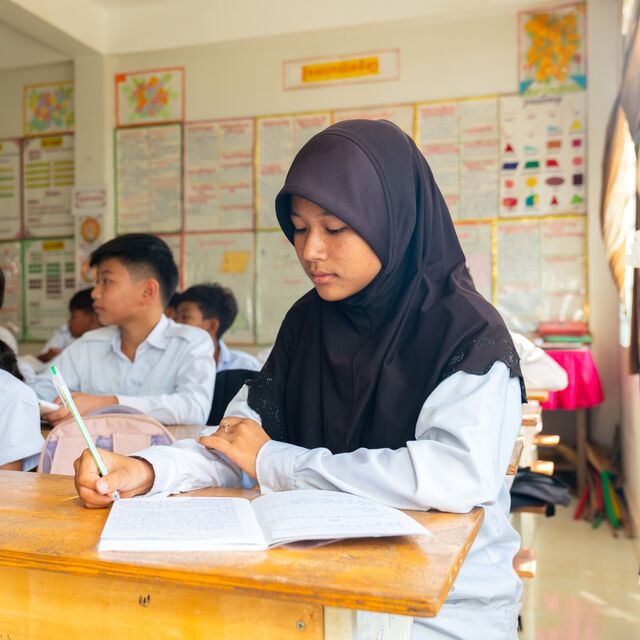
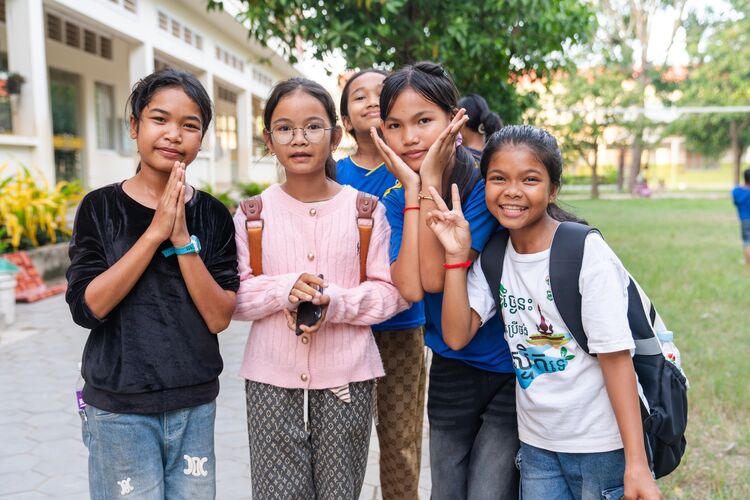
Tina is a sixth grader living in a farming village in Kampong Cham province, located in the lowlands of the Mekong River. She’s the oldest daughter of three siblings.
Cambodia
Working to make children smile again in rural Cambodia, where challenges remain in how children are treated—including the use of violent discipline.
In Cambodia, there are still cases where children experience harsh forms of discipline, including verbal or physical punishment, at school and at home. Working with communities, PEACE FOR ALL has implemented awareness-raising activities and strengthened child protection systems at 43 public elementary schools in Kampong Cham province*¹, engaging with 12,600 students in an effort to mitigate physical abuse, bullying, discrimination, and child labor. The hope is that by stopping the violence in their lives, these children can have happier days and brighter futures.
Tina is in sixth grade at elementary school. Since both her parents make a living fishing in the Mekong River, they spend lots of time away from home, leaving Tina in the care of her grandparents. Her dream is to someday become a teacher. PEACE FOR ALL is working to support her ambitions.
In collaboration with Save the Children, PEACE FOR ALL has launched a project in Cambodia called Elimination of Violence through Children’s Empowerment. Save the Children aims to use education to stop all forms of violence, whether it be in school, at home, or in communities.
What sort of violence do these children face? Too often, violence is inflicted by trusted adults who believe they are teaching discipline. Yet hitting a child or subjecting them to cruel and unreasonable verbal attacks is violence, with consequences that can endure long after the moment has passed.
In Japan, as recently as a half-century ago, people tended to shrug it off when parents or teachers used corporal punishment. Still further back, it was commonplace for children to be forced to take time away from school to help their parents in the busy farming season. Forced labor is a form of violence as well.
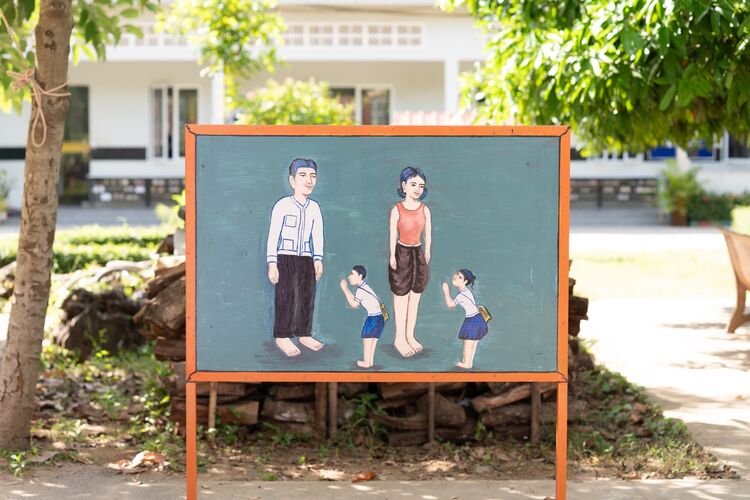
A signboard in the schoolyard representing children putting their hands together and bowing to adults.
Taking time to think for yourself
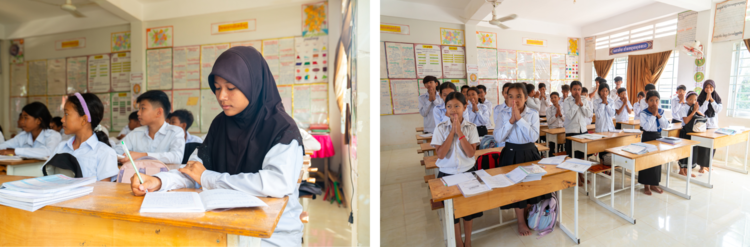
Why are violence, bullying, discrimination and child labor such serious issues? What can be done to end them? At Tina’s school, students are learning about these issues and taking actions together to put an end to violence. A sense of focus and engagement filled the classroom as they listened attentively to the lesson.
50 years ago, Cambodia went to war with neighboring Vietnam. Domestically, the Pol Pot regime carried out repression and violence targeting intellectuals, leaders of the previous government, and teachers, leaving a history in which more than 1.5 million people lost their lives. Even today, situational awareness remains necessary for activities near the Thai border.
Against this historical and ongoing backdrop, eradicating violence towards children has become a national priority in Cambodia. While the Ministry of Education has been active in the school system, addressing the problem requires not only action in educational settings, but also a shift in attitudes among parents and communities as a whole*³.
Yet another issue is that children are not certain what constitutes violence, or what to do if they become a victim. Children deserve to feel safe at school, learning with and thinking together with their classmates. They should be able to speak up and engage with each other. Once this awareness spreads among children, it can extend to their parents and into the community. It takes time, but starting there may be a reliable way forward.
Save the Children, whose mission is to advance children’s rights, has been using funds raised by PEACE FOR ALL to facilitate programs in Cambodia over the past two years, working to end violence toward children. These projects have benefited 12,600 students at 43 public elementary schools in Kampong Cham province.
Letting the children choose
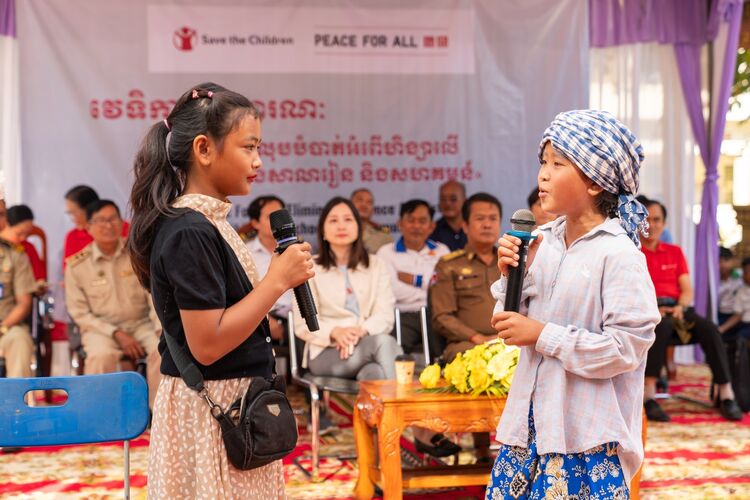
Students imagine how their parents feel, breathing life into their portrayals of grown-up characters.
After attending her first lectures at school on corporal punishment, discrimination, and child labor, Tina realized that “violent situations and patronizing behavior can happen at school too. They might discriminate because of the color of your skin, or your family situation, or insult you in ways that leave a mark.” Another important lesson Tina has learned is that violence harms not only the body, but also the mind.
Violence prevention sessions are held weekly, during student assemblies. These sessions are not one-off speeches, but are regular lessons that help deepen understanding, integrating new ideas into children’s lives.
How students convey what they learn to their parents and communities is left up to them to decide.
Two years later, students chose to spread the word through a play. By translating the violence they encounter in their daily lives into a play, the children communicated that such behavior is not acceptable. The script was created collaboratively through discussion, with roles assigned, lines learned, and ideas shared to help convey the message more effectively.
Staging the play as a community event made it easy to invite parents and neighbors to attend. Figuring out the best way to convey the importance of stopping violence was another opportunity for the students to deepen their understanding of the issue.
Getting adults to take them seriously
Students enthusiastically involved in programs to end violence.
Along with the play, panel discussions about ending violence were also held, giving children a chance to have a public dialogue with principals and local government officials—with students themselves emceeing the event.
At first, the adults in the audience seemed somewhat hesitant—but as they watched the children speak their minds so eloquently, their expressions changed to ones of serious engagement. In the end, they were deeply moved by what the children had to say.
“I want more people to know about these programs,” Tina says. “Then everyone will understand that violence is wrong, and we can all live peaceful lives...I have a dream, actually. I want to grow up and be a teacher, whose class is filled with smiling children. In my mind, peace is when kids can live without fear and imagine a bright future with a smile on their face.” Tina’s bright smile reflects the joy and optimism she carries with her.
*1 https://www.savechildren.or.jp/scjcms/sc_activity.php?c=5
*2 Based on community visit and interviews with stakeholders
*3 Cambodia’s National Plan to End Violence Against Children | UNICEF Cambodia (https://www.unicef.org/cambodia/reports/cambodias-national-plan-end-violence-against-children)
■About PEACE FOR ALL
The PEACE FOR ALL project, launched in June 2022, features T-shirts with designs expressing a wish for peace, provided voluntarily by collaborators with close ties to UNIQLO who share the goal of "taking action with a desire for world peace." Fast Retailing Co., Ltd., the company that operates UNIQLO, donates the entire profit from sales (equivalent to 20% of the unit list price in Japan) to support the activities of partner organizations around the world aiding people affected by poverty, discrimination, violence, conflict and war.
■Current Donation Recipients
UNHCR, the UN Refugee Agency https://www.unhcr.org/jp/
UNHCR, the UN Refugee Agency, is a global organization dedicated to saving lives, protecting rights and building a better future for people forced to flee their homes because of conflict and persecution. They lead international action to protect refugees, forcibly displaced communities and stateless people. They deliver life-saving assistance, help safeguard fundamental human rights, and develop solutions that ensure people have a safe place called home where they can build a better future. They also work to ensure that stateless people are granted a nationality. Their teams bring expertise, compassion, and unwavering dedication to protect and care for millions worldwide.
Save the Children https://www.savethechildren.net/
Save the Children is an international organisation that puts children first, always and everywhere. In war, in disaster, in the face of neglect. They act relentlessly, with courage and care, to protect every childhood. They keep children safe, healthy and learning, whilst tackling problems like poverty and inequality on a larger scale. Guided by children’s voices and local communities, they stay independent and uncompromising. Every action they take, every choice they make, is driven by one principle: children must come first. Save the Children currently works in around 100 countries.
Plan International https://www.plan-international.jp/
Plan International is a development and humanitarian organization that works in more than 80 countries, together with children, young people, supporters and partners to strive for a just world, where we are all equal. To do this, they tackle the root causes of the challenges and inequalities that children and girls face. Plan International is there for children from birth until adulthood and enables children to prepare for and respond to crises and adversity.
Displacement Film Fund (DFF) https://iffr.com/en/dff
The Displacement Film Fund supports the work of displaced filmmakers, as well as filmmakers who create authentic storytelling about the experiences of displaced people. Established and co-led by actor and producer Cate Blanchett, the fund was launched at the International Film Festival Rotterdam in 2025 and is managed by IFFR's Hubert Bals Fund. UNIQLO is one of the Founding Partners of this initiative.