

Five Filmmakers Selected for the Second Cycle of the Displacement Film Fund at Cannes Film Festival
Aug 10, 2026
SUSTAINABILITY
CANNES, France — On May 18, 2026 during the Cannes Film Festival, the Displacement Film Fund (DFF) introduced the filmmakers chosen for its second cycle: artists whose lives and work span different countries, histories and experiences of displacement. The short films they are now developing are scheduled to premiere at the International Film Festival Rotterdam in 2027.
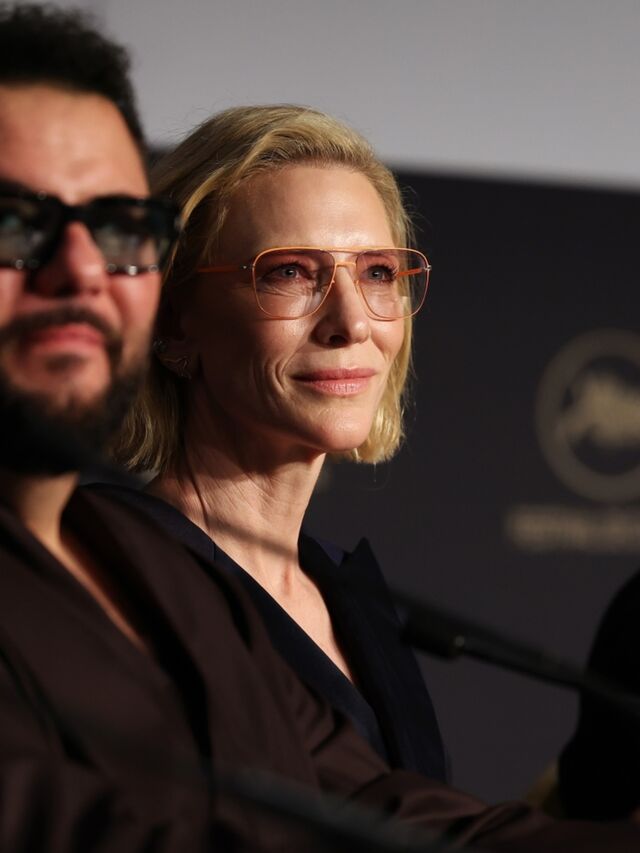
Opening the presentation, the co-founder and leader of DFF, the actor and producer Cate Blanchett, greeted the filmmakers with characteristic humor. “Your submissions and your ideas are just wildly exciting,” she said. “I can’t wait to get audiences to see them. And you better get going, because I’ve got to have them delivered by January.”
Established in 2025, the DFF supports displaced filmmakers, as well as filmmakers with a proven track record of authentic storytelling about the experiences of displaced people. Backed by a coalition of film-industry leaders, creators, philanthropists and corporate partners, the fund awards each selected filmmaker a production grant of 100,000 euros to make a short film. Its founding partners include Mastermind, UNIQLO, Droom en Daad, the Tamer Family Foundation and the Amahoro Coalition. A major partner is the SP Lohia Foundation. The Rotterdam festival serves as managing partner through its Hubert Bals Fund.
Joining Blanchett onstage were Clare Stewart, managing director of the International Film Festival Rotterdam, and four of this year's recipients: the Palestinian filmmaker Annemarie Jacir; the Vietnamese American filmmaker Bao Nguyen; the Palestinian American comedian, writer and director Mohammed Amer; and the South Sudanese filmmaker Akuol de Mabior. The fifth recipient, Cambodian director Rithy Panh, was unable to attend.
Stewart also reflected on the success of the fund's inaugural cohort. The five short films supported through the 2025 pilot edition had their world premiere at the Rotterdam festival earlier this year and were met with wide acclaim, including a five-star review from Peter Bradshaw in The Guardian. The collection will also screen at the Tokyo International Film Festival in October, she announced, and will receive a theatrical run at Film Forum in New York—a release that will help qualify the films for Academy Award consideration.
Short Films as a Space for Creative Freedom
A central aim of the fund is not to reduce displacement to a subject in itself, but to create the conditions in which established filmmakers can keep working and create films, in any genre, that build conversations and connections.
Reflecting on her decade as a Goodwill Ambassador for UNHCR, the UN Refugee Agency, Blanchett noted that the number of displaced people worldwide had risen from around 60 million when she began to more than 117 million today. “I felt my role was to put a human face on the overwhelming numbers of displacement,” she said.
What has long struck her, she explained, is that displacement remains largely absent from the stories societies tell about themselves—even from the narratives put on screen. “For people in displacement, you don’t stop being the profession that you are, whether you’re a plumber or an architect or a filmmaker,” she said. “But your career gets put on hold, and as a result those stories don’t get told.”
The idea for the fund emerged from conversations at the Global Refugee Forum in late 2023, she recalled, where a group of participants pledged to help champion and mainstream the stories of displaced artists. A chance reunion with Stewart at the BFI London Film Festival soon helped turn the concept into a concrete initiative.
She also reflected on the response to the first cycle's films at Rotterdam, which she said had cut against the polarizing rhetoric that often surrounds displacement. “Each of the films stood with their own merit as individual works of cinema,” she said. “But when you saw them together, they had a superpower.”
The decision to focus on short films was equally deliberate. “It’s often a place where you get the freedom to experiment,” Blanchett said. “Often, short films have the most sort of wild technical, visual and narrative forms of invention within them. It’s reinvigorated my love of this particular form of cinematic storytelling.” Her remarks reflected her enthusiasm for the possibilities that short films offer—and for the projects now taking shape within the fund’s second cycle.
Five Filmmakers, Five New Stories
Supported by the fund's production grants, the five filmmakers selected in the second cycle are now developing their short films. The four filmmakers present at Cannes offered deeply personal reflections on the memories, histories and experiences that lie behind the projects they hope to bring to the screen.
Jacir, a writer and producer whose four feature films have all been Palestine’s entry for the Academy Awards, described her new project as a sharp contrast to her decade-long, large-scale “Palestine 36.” This time she will work with a small team in Haifa, the city where she lives and where, she stated, 95 percent of the population was displaced in 1948. “I love the pressure of this deadline,” she said. “But that freedom of being able to explore anything, which is a challenge in itself, is the best challenge.”
She recalled sharing what she called “a very Palestinian moment” with Amer on the morning of the news conference, looking out at a Mediterranean that remains both familiar and inaccessible to many Palestinians. “It’s our sea too,” she said, “and it’s something that we’ve been severed from.” The moment reminded her of her first visit to Cannes, when she arrived with a group of Palestinians who had not seen the sea in 15 years and spent the entire festival looking at the water.
Nguyen, whose recent work includes the Emmy-nominated documentary “The Stringer” and “BTS: The Return,” spoke about his parents’ journey from Vietnam to the United States—six failed attempts to leave, two weeks at sea, a refugee camp, and finally resettlement in America. He recalled how his father, who became a janitor after arriving, would come home late and quietly sketch architectural designs. “He said, you know, if I never left Vietnam, I would have become an architect,” Nguyen said.
For a time, Nguyen planned to become a lawyer, believing he had to repay his family’s sacrifice; then he chose filmmaking instead. His project will explore shame, inheritance and the lives left behind. “It’s a story about shame and the life that you leave behind and the life that you want to leave for your children and the next generation,” he said. “Because you’re trying to adapt to a new homeland, you kind of carry these things silently for a long time.”
Amer, creator and star of the Netflix series “Mo,” reflected on humor as a survival mechanism shaped by displacement. After fleeing Kuwait during the Gulf War, he described spending more than two decades stateless. “For me, [humor has] always been like a defense mechanism,” he said. “It’s kind of like how I adapt to different environments.” Simplified images of refugees, he added, obscure the people behind them: “Once you say refugees, asylees, you just get these images that you see in the news, like people on boats. There are no real faces to it. There’s no background. It’s not humanizing at all.”
de Mabior, whose documentary “No Simple Way Home” was the first South Sudanese film selected for the Berlinale, said her new short film was born of a memory of fleeing Sudan with her sister shortly before the current war broke out. “I don’t see our experience as representative,” she said. “I hope that in telling the story, it will not be a representative story, but a story that helps us to multiply and forces people to talk about what’s going on.” One of the film’s central themes is motherhood: “I’m obsessed with the idea of mothers as custodians of history, who create objects and are like archivists in a family.” She also hopes to explore “how war unleashes an immense unraveling.”
Filmmakers First: Selection Beyond Geography
During the question-and-answer session, attention turned to the fund’s selection process. Blanchett explained that it deliberately supports not only filmmakers who have directly experienced displacement but also those shaped by its intergenerational legacy. “If you are second or third generation, and your parents made arduous journeys to provide you with the life that you have, then those traumas and those issues do get passed down,” she said.
Filmmakers were selected through a rigorous two-stage process established during the fund's inaugural year. For the second cycle, a nomination committee included journalist and documentarian Waad Al-Kateab, director and screenwriter Agnieszka Holland, UNHCR supporter Ke Huy Quan, head of the Hubert Bals Fund Tamara Tatishvili, IFFR managing director Clare Stewart and the DFF partners. Final recipients were then chosen by a selection committee chaired by Blanchett and included filmmaker Jonas Poher Rasmussen, IFFR festival director Vanja Kaludjercic, film and stage producer Barbara Broccoli, educator, activist and refugee Aisha Khurram, and DFF first-cohort filmmaker Mo Harawe.
The goal, Blanchett added, was not to categorize filmmakers by nationality, saying “their work is not based necessarily on where they come from. It’s the quality of them as filmmakers, and I think that’s really, really important to remember.” Whilst in 2025 the pilot edition included a Ukrainian, an Afghan, a Somali, a Syrian and an Iranian filmmaker she commented "there were no Palestinians. It was just the way it panned out."
Stewart added that supporting established filmmakers whose working lives are often disrupted had been a guiding principle, alongside a commitment to diverse forms of storytelling within each cycle. For her, the fund was also a practical response to an uncertain moment. “How do you take an action in this moment? What can you do in this moment?” she said. “And being managing partner of the DFF is one of the things that we can do.”
Home, Identity, and the Politics of Being Seen
Questions from the audience returned repeatedly to home, belonging and identity.
Amer reflected on the long process of becoming a U.S. citizen after growing up stateless. “The feeling of belonging and home is all you want—you want to be accepted wherever you exist in the world,” he said. Even so, a sense of loss remains. “Although I'm an American citizen, there is a gaping hole in my heart, and that's what informs my art. That is the story that I want to tell.”
For de Mabior, the question of home may have no definitive answer. “I think there might be a need to make peace with the fact that you will never completely feel at home if you’ve been displaced,” she said.
Nguyen offered another perspective, shaped by growing up between cultures. “There’s a beauty in that yearning,” he said, “not always searching for home somewhere else, but finding home in the present moment and with the people you are with at the time.”
The discussion also touched on the burden of labels. Jacir noted that journalists often ask whether she might one day make something “not political.” The distinction, she suggested, misses the point: storytellers “are simply telling the stories in our hearts and in the world, we live in.”
Amer expanded on the experience of having one’s existence politicized. “This is really difficult when your existence becomes political—when you just being yourself is politicized,” he said. “I refuse to accept it. I look at it as human-to-human interactions and seeing the other person as a human being. That’s what’s so beautiful about art. You’ll be judged on that body of work, not on you just existing as yourself.”
Solidarity as a Network Structure
The conversation then turned to a question from the audience about how storytellers can continue their work amid growing hostility toward narratives about refugees and migration.
Amer responded first, drawing on his own experience. “The only thing that I could find peace in—and it really is—is just focusing on my craft,” he said. Persistence, he argued, was the most effective response to the noise: “The only way that I’ve been able to push through is just focusing on what I need to do and not listening to comments and things online.”
Jacir argued that storytellers resist exclusion by refusing the categories imposed on them. “Nobody wants to be diminished and forced into categories of what people expect you should look like,” she said. “So the thing we do is we don’t stay inside those categories.”
Stewart pointed to another source of optimism, noting that the fund’s partners recognize the value of these stories and want to support them. “It’s a very unique kind of collaboration that Cate has brought together of individuals, of philanthropists, and the corporate support also of UNIQLO,” she said. “It’s a different way of doing business in the film industry, and it gives me hope.”
Blanchett also described the DFF’s framework of solidarity in a moment of growing headwinds, likening it to a “mycelium”, the invisible root-like network of a fungus beneath the ground through which different parts support one another. “There are many groups continuing important work,” she said. “Small groups that are struggling and exhausted but still carrying out essential work can, through solidarity, support one another.”
She closed by reflecting on collaboration among small organizations working under pressure. “There is a very big difference between being a journalist and a propagandist,” she said. “If they band together, those smaller groups can support one another. I think they could grow in strength. It’s the mycelium sort of way of working.”
As the politics of exclusion harden around questions of migration, borders and identity, the second cohort of the DFF continues to use cinema to hold human experience before its audiences in all its complexity. Rather than offering definitive answers, the filmmakers gathered in Cannes spoke of memory, longing, loss and resilience. Like a mycelial network spreading unseen beneath the surface, their individual voices remain connected across borders, histories and generations, reaching outward once more into the world.
For more information:https://www.uniqlo.com/au/en/special-feature/sustainability/displacement-film-fund
Opening the presentation, the co-founder and leader of DFF, the actor and producer Cate Blanchett, greeted the filmmakers with characteristic humor. “Your submissions and your ideas are just wildly exciting,” she said. “I can’t wait to get audiences to see them. And you better get going, because I’ve got to have them delivered by January.”
Established in 2025, the DFF supports displaced filmmakers, as well as filmmakers with a proven track record of authentic storytelling about the experiences of displaced people. Backed by a coalition of film-industry leaders, creators, philanthropists and corporate partners, the fund awards each selected filmmaker a production grant of 100,000 euros to make a short film. Its founding partners include Mastermind, UNIQLO, Droom en Daad, the Tamer Family Foundation and the Amahoro Coalition. A major partner is the SP Lohia Foundation. The Rotterdam festival serves as managing partner through its Hubert Bals Fund.
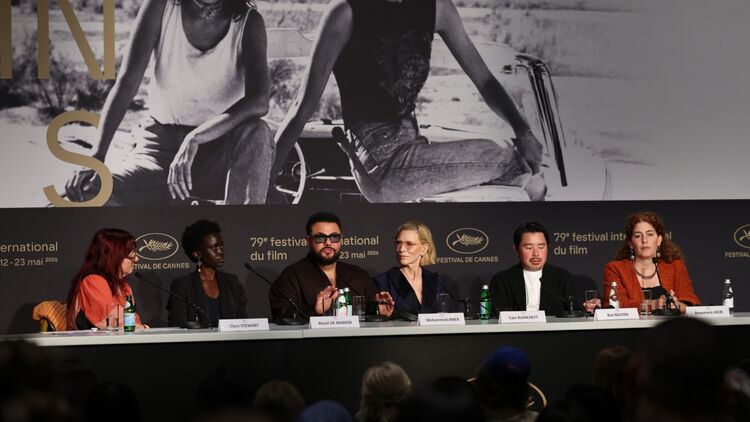
Photo: Hoda Davaine/Getty Images
Joining Blanchett onstage were Clare Stewart, managing director of the International Film Festival Rotterdam, and four of this year's recipients: the Palestinian filmmaker Annemarie Jacir; the Vietnamese American filmmaker Bao Nguyen; the Palestinian American comedian, writer and director Mohammed Amer; and the South Sudanese filmmaker Akuol de Mabior. The fifth recipient, Cambodian director Rithy Panh, was unable to attend.
Stewart also reflected on the success of the fund's inaugural cohort. The five short films supported through the 2025 pilot edition had their world premiere at the Rotterdam festival earlier this year and were met with wide acclaim, including a five-star review from Peter Bradshaw in The Guardian. The collection will also screen at the Tokyo International Film Festival in October, she announced, and will receive a theatrical run at Film Forum in New York—a release that will help qualify the films for Academy Award consideration.
Short Films as a Space for Creative Freedom
A central aim of the fund is not to reduce displacement to a subject in itself, but to create the conditions in which established filmmakers can keep working and create films, in any genre, that build conversations and connections.
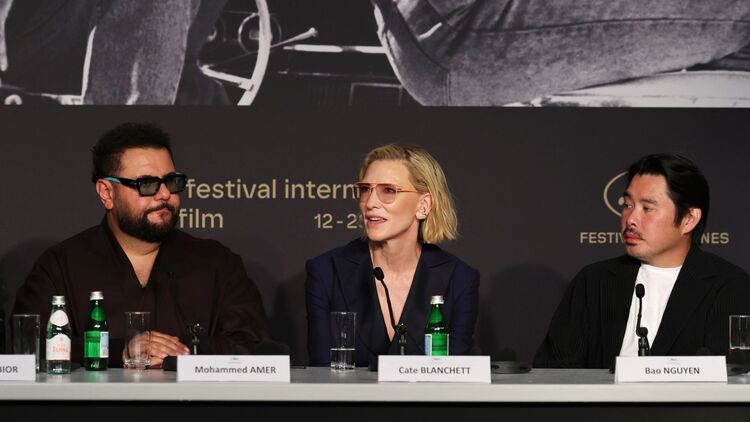
Photo: Hoda Davaine/Getty Images
Reflecting on her decade as a Goodwill Ambassador for UNHCR, the UN Refugee Agency, Blanchett noted that the number of displaced people worldwide had risen from around 60 million when she began to more than 117 million today. “I felt my role was to put a human face on the overwhelming numbers of displacement,” she said.
What has long struck her, she explained, is that displacement remains largely absent from the stories societies tell about themselves—even from the narratives put on screen. “For people in displacement, you don’t stop being the profession that you are, whether you’re a plumber or an architect or a filmmaker,” she said. “But your career gets put on hold, and as a result those stories don’t get told.”
The idea for the fund emerged from conversations at the Global Refugee Forum in late 2023, she recalled, where a group of participants pledged to help champion and mainstream the stories of displaced artists. A chance reunion with Stewart at the BFI London Film Festival soon helped turn the concept into a concrete initiative.
She also reflected on the response to the first cycle's films at Rotterdam, which she said had cut against the polarizing rhetoric that often surrounds displacement. “Each of the films stood with their own merit as individual works of cinema,” she said. “But when you saw them together, they had a superpower.”
The decision to focus on short films was equally deliberate. “It’s often a place where you get the freedom to experiment,” Blanchett said. “Often, short films have the most sort of wild technical, visual and narrative forms of invention within them. It’s reinvigorated my love of this particular form of cinematic storytelling.” Her remarks reflected her enthusiasm for the possibilities that short films offer—and for the projects now taking shape within the fund’s second cycle.
Five Filmmakers, Five New Stories
Supported by the fund's production grants, the five filmmakers selected in the second cycle are now developing their short films. The four filmmakers present at Cannes offered deeply personal reflections on the memories, histories and experiences that lie behind the projects they hope to bring to the screen.
Jacir, a writer and producer whose four feature films have all been Palestine’s entry for the Academy Awards, described her new project as a sharp contrast to her decade-long, large-scale “Palestine 36.” This time she will work with a small team in Haifa, the city where she lives and where, she stated, 95 percent of the population was displaced in 1948. “I love the pressure of this deadline,” she said. “But that freedom of being able to explore anything, which is a challenge in itself, is the best challenge.”
She recalled sharing what she called “a very Palestinian moment” with Amer on the morning of the news conference, looking out at a Mediterranean that remains both familiar and inaccessible to many Palestinians. “It’s our sea too,” she said, “and it’s something that we’ve been severed from.” The moment reminded her of her first visit to Cannes, when she arrived with a group of Palestinians who had not seen the sea in 15 years and spent the entire festival looking at the water.
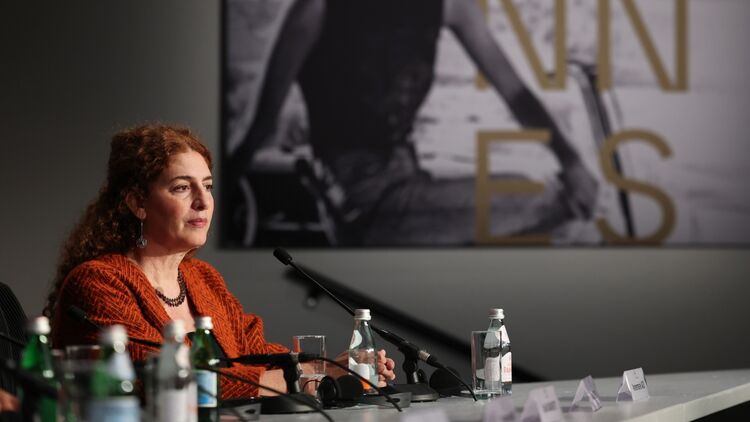
Photo: Hoda Davaine/Getty Images
Nguyen, whose recent work includes the Emmy-nominated documentary “The Stringer” and “BTS: The Return,” spoke about his parents’ journey from Vietnam to the United States—six failed attempts to leave, two weeks at sea, a refugee camp, and finally resettlement in America. He recalled how his father, who became a janitor after arriving, would come home late and quietly sketch architectural designs. “He said, you know, if I never left Vietnam, I would have become an architect,” Nguyen said.
For a time, Nguyen planned to become a lawyer, believing he had to repay his family’s sacrifice; then he chose filmmaking instead. His project will explore shame, inheritance and the lives left behind. “It’s a story about shame and the life that you leave behind and the life that you want to leave for your children and the next generation,” he said. “Because you’re trying to adapt to a new homeland, you kind of carry these things silently for a long time.”
Amer, creator and star of the Netflix series “Mo,” reflected on humor as a survival mechanism shaped by displacement. After fleeing Kuwait during the Gulf War, he described spending more than two decades stateless. “For me, [humor has] always been like a defense mechanism,” he said. “It’s kind of like how I adapt to different environments.” Simplified images of refugees, he added, obscure the people behind them: “Once you say refugees, asylees, you just get these images that you see in the news, like people on boats. There are no real faces to it. There’s no background. It’s not humanizing at all.”
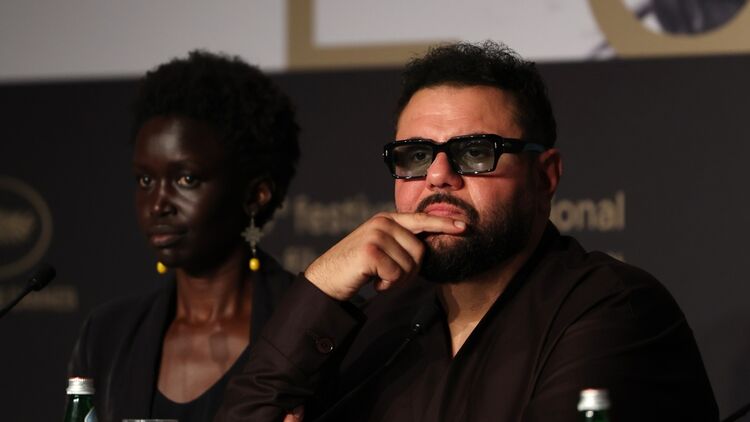
Photo: Hoda Davaine/Getty Images
de Mabior, whose documentary “No Simple Way Home” was the first South Sudanese film selected for the Berlinale, said her new short film was born of a memory of fleeing Sudan with her sister shortly before the current war broke out. “I don’t see our experience as representative,” she said. “I hope that in telling the story, it will not be a representative story, but a story that helps us to multiply and forces people to talk about what’s going on.” One of the film’s central themes is motherhood: “I’m obsessed with the idea of mothers as custodians of history, who create objects and are like archivists in a family.” She also hopes to explore “how war unleashes an immense unraveling.”
Filmmakers First: Selection Beyond Geography
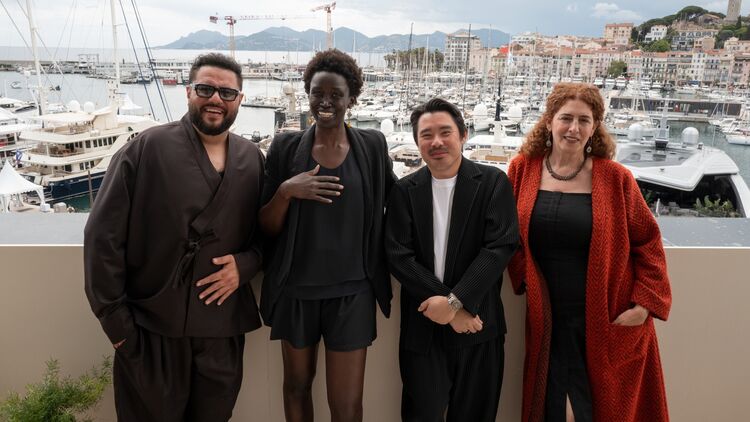
Photo: Greg Williams
From left: Mo Amer, Akuol de Mabior, Bao Nguyen, Annemarie Jacir. Rithy Panh was not present.
During the question-and-answer session, attention turned to the fund’s selection process. Blanchett explained that it deliberately supports not only filmmakers who have directly experienced displacement but also those shaped by its intergenerational legacy. “If you are second or third generation, and your parents made arduous journeys to provide you with the life that you have, then those traumas and those issues do get passed down,” she said.
Filmmakers were selected through a rigorous two-stage process established during the fund's inaugural year. For the second cycle, a nomination committee included journalist and documentarian Waad Al-Kateab, director and screenwriter Agnieszka Holland, UNHCR supporter Ke Huy Quan, head of the Hubert Bals Fund Tamara Tatishvili, IFFR managing director Clare Stewart and the DFF partners. Final recipients were then chosen by a selection committee chaired by Blanchett and included filmmaker Jonas Poher Rasmussen, IFFR festival director Vanja Kaludjercic, film and stage producer Barbara Broccoli, educator, activist and refugee Aisha Khurram, and DFF first-cohort filmmaker Mo Harawe.
The goal, Blanchett added, was not to categorize filmmakers by nationality, saying “their work is not based necessarily on where they come from. It’s the quality of them as filmmakers, and I think that’s really, really important to remember.” Whilst in 2025 the pilot edition included a Ukrainian, an Afghan, a Somali, a Syrian and an Iranian filmmaker she commented "there were no Palestinians. It was just the way it panned out."
Stewart added that supporting established filmmakers whose working lives are often disrupted had been a guiding principle, alongside a commitment to diverse forms of storytelling within each cycle. For her, the fund was also a practical response to an uncertain moment. “How do you take an action in this moment? What can you do in this moment?” she said. “And being managing partner of the DFF is one of the things that we can do.”
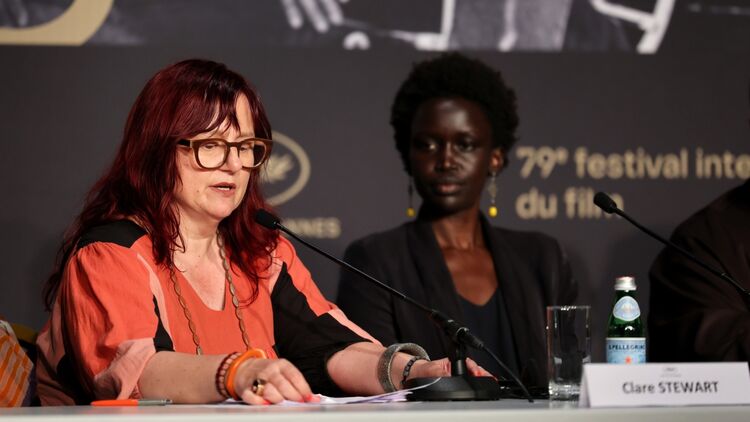
Photo: Hoda Davaine/Getty Images
Home, Identity, and the Politics of Being Seen
Questions from the audience returned repeatedly to home, belonging and identity.
Amer reflected on the long process of becoming a U.S. citizen after growing up stateless. “The feeling of belonging and home is all you want—you want to be accepted wherever you exist in the world,” he said. Even so, a sense of loss remains. “Although I'm an American citizen, there is a gaping hole in my heart, and that's what informs my art. That is the story that I want to tell.”
For de Mabior, the question of home may have no definitive answer. “I think there might be a need to make peace with the fact that you will never completely feel at home if you’ve been displaced,” she said.
Nguyen offered another perspective, shaped by growing up between cultures. “There’s a beauty in that yearning,” he said, “not always searching for home somewhere else, but finding home in the present moment and with the people you are with at the time.”
The discussion also touched on the burden of labels. Jacir noted that journalists often ask whether she might one day make something “not political.” The distinction, she suggested, misses the point: storytellers “are simply telling the stories in our hearts and in the world, we live in.”
Amer expanded on the experience of having one’s existence politicized. “This is really difficult when your existence becomes political—when you just being yourself is politicized,” he said. “I refuse to accept it. I look at it as human-to-human interactions and seeing the other person as a human being. That’s what’s so beautiful about art. You’ll be judged on that body of work, not on you just existing as yourself.”
Solidarity as a Network Structure
The conversation then turned to a question from the audience about how storytellers can continue their work amid growing hostility toward narratives about refugees and migration.
Amer responded first, drawing on his own experience. “The only thing that I could find peace in—and it really is—is just focusing on my craft,” he said. Persistence, he argued, was the most effective response to the noise: “The only way that I’ve been able to push through is just focusing on what I need to do and not listening to comments and things online.”
Jacir argued that storytellers resist exclusion by refusing the categories imposed on them. “Nobody wants to be diminished and forced into categories of what people expect you should look like,” she said. “So the thing we do is we don’t stay inside those categories.”
Stewart pointed to another source of optimism, noting that the fund’s partners recognize the value of these stories and want to support them. “It’s a very unique kind of collaboration that Cate has brought together of individuals, of philanthropists, and the corporate support also of UNIQLO,” she said. “It’s a different way of doing business in the film industry, and it gives me hope.”
Blanchett also described the DFF’s framework of solidarity in a moment of growing headwinds, likening it to a “mycelium”, the invisible root-like network of a fungus beneath the ground through which different parts support one another. “There are many groups continuing important work,” she said. “Small groups that are struggling and exhausted but still carrying out essential work can, through solidarity, support one another.”
She closed by reflecting on collaboration among small organizations working under pressure. “There is a very big difference between being a journalist and a propagandist,” she said. “If they band together, those smaller groups can support one another. I think they could grow in strength. It’s the mycelium sort of way of working.”
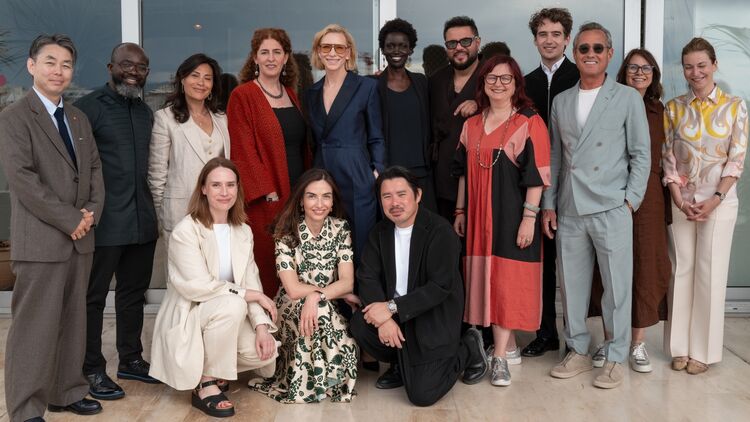
Photo: Greg Williams
A group photo of the partners, selected directors, and affiliates of the Displacement Film Fund (DFF) Second Cycle, taken on the terrace at the Cannes Film Festival venue. The diverse group is smiling together, centered around Cate Blanchett and Clare Stewart.
As the politics of exclusion harden around questions of migration, borders and identity, the second cohort of the DFF continues to use cinema to hold human experience before its audiences in all its complexity. Rather than offering definitive answers, the filmmakers gathered in Cannes spoke of memory, longing, loss and resilience. Like a mycelial network spreading unseen beneath the surface, their individual voices remain connected across borders, histories and generations, reaching outward once more into the world.
For more information:https://www.uniqlo.com/au/en/special-feature/sustainability/displacement-film-fund