

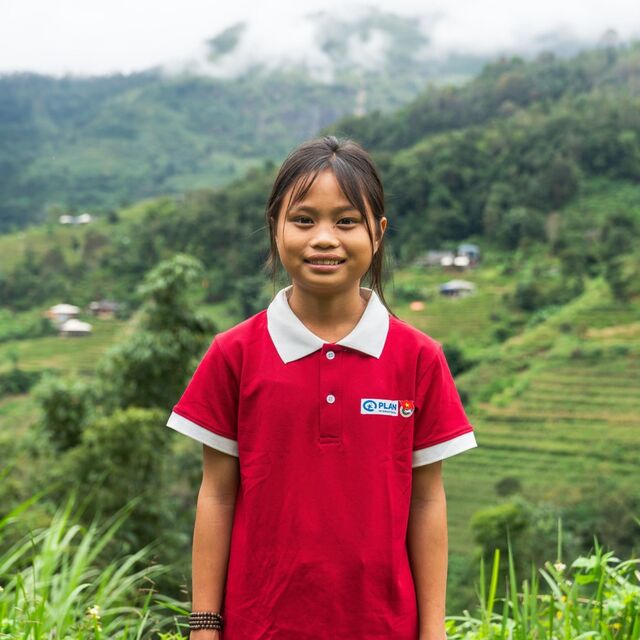
A single T-shirt has the power to spread peace. ~ The Power of Clothing No.29 ~
S, in middle school, is the third of eight children. Her family farms and raises cattle.
Vietnam
My family lives in the northernmost village in the mountains of Vietnam. The road to school is dangerous, and lots of girls get married before eighteen.
Vietnam shares its northern border with China. This mountainous region is marked by modest livestock operations. The poverty rate is high, and girls have long been encouraged to marry young, rather than attend school. Marriage leads to pregnancy and long days filled with parenting as well as housework and farming. Recently, schools have been encouraging girls to value themselves and make their own decisions.
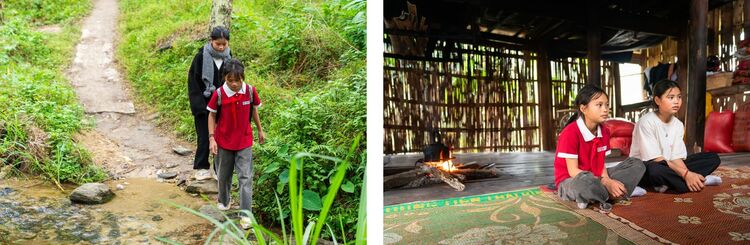
Homes in the region continue to use a wooden raised-floor structure. Food is cooked over an open hearth. It’s common to keep cows on the lower level. Children travel to school on steep roads, passing mountain streams along the way. Getting to school in bitter cold or rainy weather is a challenge.
According to Vietnam’s Law on Marriage and Family, passed in 2014, girls under eighteen (and boys under twenty) are prohibited from marrying, but such laws are difficult to enforce in rural areas, where longstanding customs remain deeply rooted.
What sorts of problems do girls face when they’re forced to marry or have children too early, while they’re still growing emotionally and physically.
These girls contend with a number of issues. First, giving birth at such a young age can be harmful to the mother’s growing body. Parenting also leaves many girls with no choice but to quit school. Furthermore, it’s customary for the household that “receives” the girl to pay a bride dowry, which puts the young wife in a subservient position and makes it hard for her to have a voice.
This is how early marriage deprives children of the right to determine the course of their lives for themselves.
Making life harder for girls
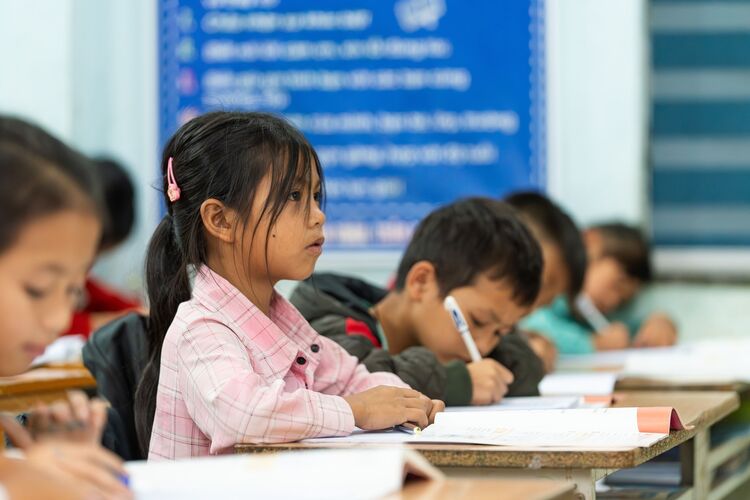
Expanding dorms and offering meals appears to have improved classroom concentration levels.
For children who live far away, there is a dormitory that also provides meals, but a shortage of rooms means not all students can live there. As a result, she has to walk all the way home again for lunch. Deeply held beliefs that girls should help around the house, rather than go to class, have gradually made her drift away from school.
These circumstances—all too common in the mountains of northern Vietnam—deprive girls of their independence and continue the cycle of poverty.
For years, Plan International has been running awareness programs to help women reclaim the independence, equality, and health taken from them by child marriage. With support and funding from PEACE FOR ALL, they’ve built a framework for improving the adverse conditions of girls living in the mountains of northern Vietnam.
Improving learning environments and developing curricula are of critical importance.
To improve access to schools, dormitories are now prioritizing students living over 4.5 kilometers away, while the dorms themselves are being renovated and expanded.
Dorms offering meals
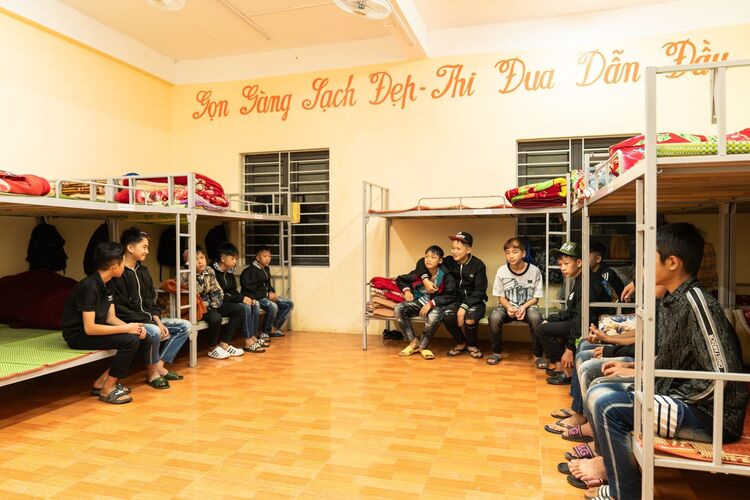
Text on the wall of the boy’s dorm: “Keep things neat and tidy, every day.”
Expanding dorms and offering meals appears to have improved classroom concentration levels.
Septic facilities for toilets and sanitary handwashing areas have been improved to
accommodate a growing student population.
Improving sanitary conditions not only supports wellness, it also allows students to show each other mutual respect. It’s also crucial to expand the material taught in schools. Adding comprehensive sexuality education to the curriculum requires educating teachers too. These sex ed programs cover not only health basics like menstruation, puberty, pregnancy, and contraception, but also abortion, HIV/AIDS, harmful practices like child marriage, and gender-based violence. Teachers required their own training to understand specifically how to engage with these issues.
Throughout these lessons, S and her peers kept coming back to the ideas of being in charge of their own bodies, valuing themselves, and making their own decisions.
Rather than simply go along with what their parents say, children have the right to say no, and to make their own choices about who they marry. Child marriage harms both their bodies and their future, and learning to stand up and say no is key.
Imagining bright futures with PEACE
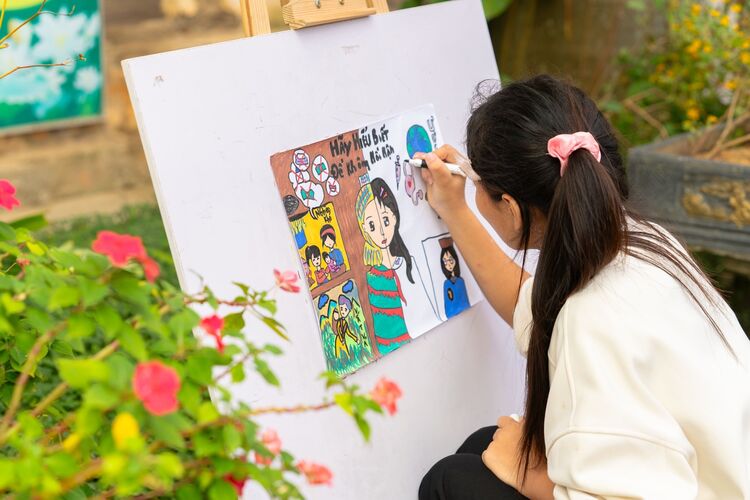
Imagination is key to thinking about the future. Turning life’s circumstances into a picture, searching for the road ahead.
After stepping away from school, S started going to class again. Looking back, she realized that the things she learned from the PEACE FOR ALL project had shaped her future.
“Lots of girls drop out of school because they’re forced to marry young,” S said quietly. “I’m so lucky that I had the chance to learn that I could value myself and still show respect for others.”
To help foster awareness and action among students, Plan International has launched the Champions of Change program, a global initiative working to promote gender equality and transform social norms among young people. Elected as the leader of her group, S speaks openly with her classmates and engages with the teachers.
S used to be so serious in school, but since becoming a leader, there’s a new light in her eyes and she smiles more. “I have so much fun with my friends at school.”
Remote mountain areas have high poverty rates, and poverty can lead to child labor and child marriage. This closes all kinds of doors for girls, placing the physical and emotional burden solely on their shoulders—and yet this doesn’t solve the core problem of poverty.
PEACE is when kids can imagine a bright future. Spending their days free from care. S isn’t just thinking about her own future.
“I want to do my best so I can grow up into someone who can help my parents.”
*1 Results of the 2024 Review of Poor and Near-Poor Households According to the 2022-2025 Multidimensional Poverty Standard Nationwide (Attached to Decision No. 217/QD-BLDTBXH dated February 4, 2025 of the Ministry of Labour, Invalids and Social Affairs)
*2 Plan International Vietnam’s Village Factsheets, 2020
*3 The Viet Nam Population and Housing Census of 00:00 Hours on April 2019
■About PEACE FOR ALL
The PEACE FOR ALL project, launched in June 2022, features T-shirts with designs expressing a wish for peace, provided voluntarily by collaborators with close ties to UNIQLO who share the goal of "taking action with a desire for world peace." Fast Retailing Co., Ltd., the company that operates UNIQLO, donates the entire profit from sales (equivalent to 20% of the unit list price in Japan) to support the activities of partner organizations around the world aiding people affected by poverty, discrimination, violence, conflict and war.
■Current Donation Recipients
UNHCR, the UN Refugee Agency https://www.unhcr.org/jp/
Save the Children https://www.savethechildren.net/
Plan International https://www.plan-international.jp/
Displacement Film Fund (DFF) https://iffr.com/en/dff

This article is the second installment of a three-part PEACE FOR ALL feature in The Power of Clothing Issue 29. The final installment will be featured on August 24.
S, in middle school, is the third of eight children. Her family farms and raises cattle.
Vietnam
My family lives in the northernmost village in the mountains of Vietnam. The road to school is dangerous, and lots of girls get married before eighteen.
Vietnam shares its northern border with China. This mountainous region is marked by modest livestock operations. The poverty rate is high, and girls have long been encouraged to marry young, rather than attend school. Marriage leads to pregnancy and long days filled with parenting as well as housework and farming. Recently, schools have been encouraging girls to value themselves and make their own decisions.
Homes in the region continue to use a wooden raised-floor structure. Food is cooked over an open hearth. It’s common to keep cows on the lower level. Children travel to school on steep roads, passing mountain streams along the way. Getting to school in bitter cold or rainy weather is a challenge.
According to Vietnam’s Law on Marriage and Family, passed in 2014, girls under eighteen (and boys under twenty) are prohibited from marrying, but such laws are difficult to enforce in rural areas, where longstanding customs remain deeply rooted.
What sorts of problems do girls face when they’re forced to marry or have children too early, while they’re still growing emotionally and physically.
These girls contend with a number of issues. First, giving birth at such a young age can be harmful to the mother’s growing body. Parenting also leaves many girls with no choice but to quit school. Furthermore, it’s customary for the household that “receives” the girl to pay a bride dowry, which puts the young wife in a subservient position and makes it hard for her to have a voice.
This is how early marriage deprives children of the right to determine the course of their lives for themselves.
Making life harder for girls
Expanding dorms and offering meals appears to have improved classroom concentration levels.
For children who live far away, there is a dormitory that also provides meals, but a shortage of rooms means not all students can live there. As a result, she has to walk all the way home again for lunch. Deeply held beliefs that girls should help around the house, rather than go to class, have gradually made her drift away from school.
These circumstances—all too common in the mountains of northern Vietnam—deprive girls of their independence and continue the cycle of poverty.
For years, Plan International has been running awareness programs to help women reclaim the independence, equality, and health taken from them by child marriage. With support and funding from PEACE FOR ALL, they’ve built a framework for improving the adverse conditions of girls living in the mountains of northern Vietnam.
Improving learning environments and developing curricula are of critical importance.
To improve access to schools, dormitories are now prioritizing students living over 4.5 kilometers away, while the dorms themselves are being renovated and expanded.
Dorms offering meals
Text on the wall of the boy’s dorm: “Keep things neat and tidy, every day.”
Expanding dorms and offering meals appears to have improved classroom concentration levels.
Septic facilities for toilets and sanitary handwashing areas have been improved to
accommodate a growing student population.
Improving sanitary conditions not only supports wellness, it also allows students to show each other mutual respect. It’s also crucial to expand the material taught in schools. Adding comprehensive sexuality education to the curriculum requires educating teachers too. These sex ed programs cover not only health basics like menstruation, puberty, pregnancy, and contraception, but also abortion, HIV/AIDS, harmful practices like child marriage, and gender-based violence. Teachers required their own training to understand specifically how to engage with these issues.
Throughout these lessons, S and her peers kept coming back to the ideas of being in charge of their own bodies, valuing themselves, and making their own decisions.
Rather than simply go along with what their parents say, children have the right to say no, and to make their own choices about who they marry. Child marriage harms both their bodies and their future, and learning to stand up and say no is key.
Imagining bright futures with PEACE
Imagination is key to thinking about the future. Turning life’s circumstances into a picture, searching for the road ahead.
After stepping away from school, S started going to class again. Looking back, she realized that the things she learned from the PEACE FOR ALL project had shaped her future.
“Lots of girls drop out of school because they’re forced to marry young,” S said quietly. “I’m so lucky that I had the chance to learn that I could value myself and still show respect for others.”
To help foster awareness and action among students, Plan International has launched the Champions of Change program, a global initiative working to promote gender equality and transform social norms among young people. Elected as the leader of her group, S speaks openly with her classmates and engages with the teachers.
S used to be so serious in school, but since becoming a leader, there’s a new light in her eyes and she smiles more. “I have so much fun with my friends at school.”
Remote mountain areas have high poverty rates, and poverty can lead to child labor and child marriage. This closes all kinds of doors for girls, placing the physical and emotional burden solely on their shoulders—and yet this doesn’t solve the core problem of poverty.
PEACE is when kids can imagine a bright future. Spending their days free from care. S isn’t just thinking about her own future.
“I want to do my best so I can grow up into someone who can help my parents.”
*1 Results of the 2024 Review of Poor and Near-Poor Households According to the 2022-2025 Multidimensional Poverty Standard Nationwide (Attached to Decision No. 217/QD-BLDTBXH dated February 4, 2025 of the Ministry of Labour, Invalids and Social Affairs)
*2 Plan International Vietnam’s Village Factsheets, 2020
*3 The Viet Nam Population and Housing Census of 00:00 Hours on April 2019
■About PEACE FOR ALL
The PEACE FOR ALL project, launched in June 2022, features T-shirts with designs expressing a wish for peace, provided voluntarily by collaborators with close ties to UNIQLO who share the goal of "taking action with a desire for world peace." Fast Retailing Co., Ltd., the company that operates UNIQLO, donates the entire profit from sales (equivalent to 20% of the unit list price in Japan) to support the activities of partner organizations around the world aiding people affected by poverty, discrimination, violence, conflict and war.
■Current Donation Recipients
UNHCR, the UN Refugee Agency https://www.unhcr.org/jp/
Save the Children https://www.savethechildren.net/
Plan International https://www.plan-international.jp/
Displacement Film Fund (DFF) https://iffr.com/en/dff